Robert brown first observed though a microscope the jerky movement of pollen particles in water. This jostling can also be observed in an airborne smoke particle, the average speed of air molecule is 1000mph. Although an atom cannot be seen the existence of atoms can be inferred empirically. The force acted onto the pollen or smoke particle by the atom is tiny however, movement occurs because of imbalances in the acting kinetic forces, knocking the particle in jerky movements. The seemingly uniform pattern of Brownian motion is a fractal. Temperature is the mean squared velocity therefore if the temperature is increased a greater activity of motion is observed. Einstein popularised Robert browns 19th century idea and thwarted atomic theory sceptics of the early 20th century.
Sunday, 8 May 2011

Kinetic Theory & Pressure law
In 1859 James Klerk Maxwell speculated on the properties of air based on almost prophetic postulates. J. C. Maxwell visualised air particles as tiny solid spheres travelling distances that are much greater than their diameters. Maxwell presumed all particles in a gas volume are initially at random positions. Maxwell devised as though experiment in which the law of entropy may be breached if the particle in given volume could be spontaneously organised, dubbed by lord kelvin as Maxwell’s dæmon.
The average speed of an air molecule is 1000mph. Maxwell postulated molecules travel between collisions at a constant speed. Interactions between particles conserve energy but still some will deviate from average greatly, traveling much faster or slower than average velocity. Maxwell prophesised the properties of the ‘at the time’ undiscovered Nobel gases in his ideal gas model which overlooked the influence of intermolecular forces.
Maxwell’s insights into the properties of gases allowed him to create a new definition of temperature. Temperature is now understood as the mean squared velocity, because temperature is directly proportional to pressure (at constant volume and mass). Pressure is the force per unit area exerted on the inside of a container. Therefore Maxwell’s ideal gas laws describe the relationship between pressure per unit area and the frequency of collisions in a given volume. Pressure is the kinetic energy of gas particles colliding with the inside of a container.
Principles of Atomic Bonding
Covalent Bonding & Ionic Bonding
Atoms are constantly striving for eight electrons in their outer shell; this is called the octet rule. In order achieve an outer shell of eight they must be willing to share or receive different amounts of electrons; valence is an atoms capacity to from bonds. Interaction between unpaired electrons and vacancies in energy shells are the cause of all atomic bonding. Ionic and covalent bonds are opposing ends of a spectrum of electrostatic interaction between atoms or ions. In reality there is a gradient from one to another.
Atoms are constantly striving for eight electrons in their outer shell; this is called the octet rule. In order achieve an outer shell of eight they must be willing to share or receive different amounts of electrons; valence is an atoms capacity to from bonds. Interaction between unpaired electrons and vacancies in energy shells are the cause of all atomic bonding. Ionic and covalent bonds are opposing ends of a spectrum of electrostatic interaction between atoms or ions. In reality there is a gradient from one to another.

Figure 1; triple covalent bond in nitrogen
Electrons interact in pairs– electrons negotiate their repelling charges via spin pair repulsion. Negatively charged covalence electrons may also reel electro-positive nuclei together. All bonds between any non-metallic substances will be covalent. A covalent bond is when neither atom has the strength of attraction to fully remove an electron from the other and orbiting electron pairs can be shared between two atoms. Nitrogen is not naturally found as an individual atom but is diatomic and occurs as an N2 molecule. Nitrogen has three valence electrons and five electrons in its outermost P-orbital. Nitrogen requires three in its outer shell to complete its octet. By sharing three electrons each. They now have six in their P-orbital - each nitrogen is allowed a temporary octet, including their inner 1s2 orbits. A dative covalent bond occurs when an electron pair is donated to an acceptor atom - dative covalent bonds are weaker.
Many simple covalent molecules have low boiling points e.g. nitrogen, ethanol, carbon dioxide and ammonia are all gasses at room temperature. N2 shares three pairs of electrons therefore N2 has three covalent bonds; each bond is named successively as s, p, and d. Three is the maximum amount of covalent bonds two atoms can share. It’s common for covalent substances to be water-insoluble; polymers and oils are covalent substances.

Figure 2; Ionic bonding in sodium chloride
Although covalent bonding is stronger – having a greater bond enthalpy than ionic bonding; ionic compounds are crystalline solids often with very high boiling points. An ionic bond forms when an electron is permanently removed and attached to another atom to form two oppositely charged ions. Oppositely charged ions are attracted to one another by electrostatic. Ionic bonds typically occur between metals and non-metals. Metals are very ready to pass on electrons; they are conductive and reduction agents. Non-metals are often oxidising agents and have a tight nuclear radius and therefore high electronegativity. When you react sodium and chlorine – sodium oxidizes to become a positively charged cation. Chlorine accepts an electron and is therefore reduced to from a negatively charged anion, forming NaCl. Sodium chloride is a brittle solid due to its ionic lattice. NaCl crystals, like many other ionic compounds (e.g. salts and acids) are soluble in water. Aqueous or molten ionic compounds are conductive.
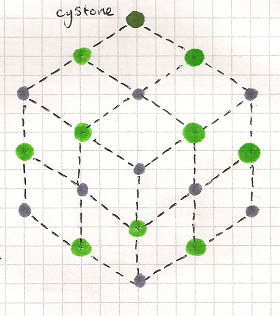
Figure 3; Three-dimensional ionic lattice in sodium chloride
Intermolecular Forces
Circular visualisations of electron orbitals are a simplification. The actual path of an electron is defined by its orbital An orbital is in fact a cloud of the probable position of an electron, in effect the density of the cloud signifies where an electron is likely to be. An electron has the potential to deviate from its predicted position quite dramatically! Therefore in an atom electrons are not completely evenly distributed across the orbitals - where the majority of the electrons occupy a negative charge (d-) is induced; on the opposing side the proton creates a positive charge (d+); this is called a dipole. Dipoles can have a ‘domino effect’ by causing synchronisation of charge distribution among atoms in a close vicinity- this is called an instantaneous dipole is induced dipole. These weak intermolecular forces are also known as Van Der Waals forces.
Circular visualisations of electron orbitals are a simplification. The actual path of an electron is defined by its orbital An orbital is in fact a cloud of the probable position of an electron, in effect the density of the cloud signifies where an electron is likely to be. An electron has the potential to deviate from its predicted position quite dramatically! Therefore in an atom electrons are not completely evenly distributed across the orbitals - where the majority of the electrons occupy a negative charge (d-) is induced; on the opposing side the proton creates a positive charge (d+); this is called a dipole. Dipoles can have a ‘domino effect’ by causing synchronisation of charge distribution among atoms in a close vicinity- this is called an instantaneous dipole is induced dipole. These weak intermolecular forces are also known as Van Der Waals forces.
Dipoles can also be induced in molecules. Chlorine is diatomic; a chloride molecule is non-polar. Each chlorine atom has the same electronegativity therefore balanced forces of attraction allow for electrons to orbit impartially. There is an even distribution of electrostatic across their covalence orbital.

Figure 4; Polarity of a hydrogen-chloride molecule
Atoms have a force of attraction, this attracts electrons in a covalent bond, this called electronegativity. Electronegativity increases across a period and up through the groups – it would be fair to make the observation that it is related to atomic radius and levels of shielding, although evidently not completely due to irregularity in observed periodicity. In covalent compounds the constituent atoms are likely to have an imbalance in their electronegativity. This causes polarity in these molecules because the electrons will be biased to occupy one partnering atom over another. Hydrogen chloride HCL is a polar molecule – it has permanent dipole in which hydrogen is partially positively charged (d+) and chlorine is partially negative (d-). Similarly with Van Der Waals forces, permanent dipoles have influence on neighbouring particles; these are dipole-dipole interactions.
Hydrogen Bonds; Intermolecular Forces Continued
Hydrogen bonds are the strongest type of intermolecular forces and are essential for life on earth – they are present in water. Water is the medium in which all cell metabolism, interaction and biochemical synthesis is carried out. Hydrogen bonds are the present in a great deal of organic molecules.
A hydrogen bond is a relationship between a donor and an acceptor. The low electronegativity of hydrogen when bonded to a highly electronegative atom with a small physical radius - hydrogen’s proton is left almost completely unshielded, adopting a strong partially positive charge (d+). Hydrogen acts as a donor and is strongly attracted to unpaired electrons. Hydrides of nitrogen, oxygen and fluorine and that act as both an acceptor and a donor; intermolecular hydrogen bonds.
It’s important to understand that hydrogen bonds are at dipole-dipole interaction but are individualized because of their distinct properties. There are varying strengths of hydrogen bonds. Strong hydrogen bonds are more comparable to covalent or ionic bonds but are far weaker. Strong hydrogen dipole-dipole forces, strong hydrogen bonds occur in hydride anions in specialized conditions.
Moderate and weak hydrogen bonds are electrostatic attraction weaker than ionic. Moderate hydrogen bonds are the area of the most practical interest. The presence of moderate hydrogen bonds is reasonable for the unusual boiling point of water in comparison to other hydrides. Ice has a greater volume (therefore lower density) than water because hydrogen bonds organise oxidane particles into a lattice; hydrogen bonds are often represented by a dotted line. The strong polarisation of oxidane makes it a perfect solvent for many organic and inorganic reactions.

Figure 5; Two-dimensional visualisation of water molecules in a frozen lattice

Figure 7; Hydrogen bonding in two genetic base pairs (left guanine) (right cytosine)
By Caspar Zialor
Chemistry 1 by Brian Ratcliff, Helen Eccles, David Johnson, John Nicholson and John Raffan. 2003 | 08/11/2010 |
An Introduction To hydrogen Bonding by George A. Jeffrey 1997 |
Wednesday, 4 May 2011
Social Darwinism
Not publicly supported by Darwin himself. Social Darwinism has been used to support right wing political ideologies and has been used as a means to perpetuate existing stratified social structures. It main doctrine is that a factor such as intelligence or likely-hood to commit violent crime is predetermined at birth. Much of the evidence was found in concordances between monozygotic twins.
The discovery of was a revelation for social theorists. However application of selective breeding among domesticated animals is centuries old. Prior to the publications of Charles Darwin’s Origin of Species (published 1858), English political economist Robert Malthus (1766-1834) was first to suggest the potential benefits of selective breeding among human beings. Malthus is famous for his scientific contribution of Malthusian growth, which you may recognise from when we looked at ecology. Robert also devised the Malthusian catastrophe an idealised situation in which he discussed the benefits of famines and diseases in aid of wiping out the lower strata’s of society. Charles Darwin’s half cousin Francis Galton (1822-1911) coined the term eugenics and created new with it a new biosocial movement Galton feared the effects human civilisation would have on the natural selection of mankind and predicted a degeneration of the quality of the human gene pool. During World War II the grim reality of the application of human breeding programs and sterilisation, euthanasia and extermination of undesirables became realised under the rule of Adolf Hitler who became leader of the Nazi party in 1921 until his eventual suicide in 1945.
Tuesday, 3 May 2011
Evolution
Simple cells are thought to have evolved 3.5 billion years ago. The earth is approximately 4.6 billion years of age. The simple life forms were algae like micro-organisms and later, cyanobacteria which were responsible for the great increase in oxygen towards the end of the first era known as the Achaean. Actual algae occurred much later at the dawn of the second Proterozoic era around 2.5 billion years ago. 400 million years ago, during the Palaeozoic era, plants colonised the land. Evolution may be defined as the process by which species undergo transmutation over geological time. Evolution is a core theme of biology, all life on earth today comes from a common ancestor and incorporates genetics, systematics, palaeontology, developmental biology, behavioural psychology and ecology. The mechanisms of evolution by natural selection are variation within a population, superfluous fecundity, limits on population growth and heredity success. Individuals with the most favourable combination of characteristics are most likely to survive and reproduce therefore adaptive traits accumulate in a population. New species arise by divergence. This may due geographic, behavioural-social or physical limitation on interbreeding between populations. Comparatively the anatomy of two different species may share homologous features they have inherited from a common ancestor. The similarities between Abolocetus and the modern whale is an example of divergent evolution. Similarly two species may look very similar but only have a very distant common ancestor. By convergent evolution they have adapted to similar niches in the specific ecosystem. The fusiform shaped shared by whales and fish as result of the high density of water is an example of analogous or homoplastic features.
Thursday, 28 April 2011
DNA - Basic Structure
Supported by a sugar phosphate backbone; the 3’ carbon of the ribose link to the adjacent deoxynucleotide 5’ carbon by phosphodiester bridges during polymerisation. During this synthesis helicase unzips the DNA and polymerase utilises triphosphate Okazaki fragments whilst synthesising the leading 5’ carbon stand - the lagging 3’ carbon strand with the use of primers. The bases pair up: adenine (A) to thymine (T) and guanine (G) and cytosine (C). A to T has two hydrogen bonds and G to C has three hydrogen bonds.
Bases can exist in two tautometric forms, the standard enol from and rare keto form. Tautomers are a type of isomerism. Other types of isomerism include geometric isomerism, cis meaning on the same side and trans meaning across. Optical isomers are non-superimposable mirror image enantiomers. Tautometric isomerism leads to mispairing of bases. DNA’s structure is best retained at high humidity and low salt known as B-DNA . Denaturisation may occur at high temperatures, within alkali solution and in concentrated methanal (formaldehyde) or urea.
Monday, 28 February 2011
Frank Herbert's Dune
Copy write 1965, Frank Herbert's Dune captured my imagine nation from start until finish and truly had me in suspense at the end which is rare, for all my effort to avoid plot spoilers I must admit I accidentally read some. Dune captures so much epicness! In this book you observe a son of a murdered father and his mother first be indoctrinated into perhaps the most violent community imaginable. Then face the empire that ha done wrong to them in a tale that is political as much as it is amazing. The planet Akkaris where most of the happenings take place has a diverse history an even an fictional ecosystem. I enjoyed this book so much I also got the film as to hang on to its essence a little while longer. I know it wont be as good but it should be a fun night in.
Tuesday, 18 January 2011
Posthumanism
The British Broadcasting news web site openly speaks of the reality of the right wing results in of current class structure.
The divide in the human race in this article is said in principle to be due to a over reliance on technology. However the tendency for like-minded to have children together plays a large factor in modern human sexual selection. People of similar intelligence, attractiveness and social standing are far more likely to have children together. This will therefore have its effect on future generations. Especially in the upper classes consisting of the greatest minority’s of people of the world and often composed of ‘intellectuals’ will see the greatest divergence in their biology in the coming centuries.

The divide in the human race in this article is said in principle to be due to a over reliance on technology. However the tendency for like-minded to have children together plays a large factor in modern human sexual selection. People of similar intelligence, attractiveness and social standing are far more likely to have children together. This will therefore have its effect on future generations. Especially in the upper classes consisting of the greatest minority’s of people of the world and often composed of ‘intellectuals’ will see the greatest divergence in their biology in the coming centuries.
Wednesday, 12 January 2011
Foundation by Isaac Asimov, 1951
Truly epic story capturing in exiting realism the speculated sociopolitical and economic crises in a distant future of an entirely populated galactic empire. The book is set over a vast space of time and the foundation covers 3 generations of characters. Asimov isn't the heavy weight in science fiction.
Their is a movie set to be directed by Michael Emmerich and i have fears that the holly wood cinema will not do the full content justice. I found this book impossible to put down, the copy i had was missing a few pages however I am buying the entire saga with a replacement on ebay.com and look forward to my next installment. the cover is by tim white and the art really capture my imagination! i refuse to buy any other publishing exempt for the the ones sporting this dated but awesome design.

Their is a movie set to be directed by Michael Emmerich and i have fears that the holly wood cinema will not do the full content justice. I found this book impossible to put down, the copy i had was missing a few pages however I am buying the entire saga with a replacement on ebay.com and look forward to my next installment. the cover is by tim white and the art really capture my imagination! i refuse to buy any other publishing exempt for the the ones sporting this dated but awesome design.
Wednesday, 5 January 2011
George Orwell's - 1984
I was in a book shop in Muswell Hill today and over heard a the employees, (among poorly explained warnings of a coming world economic superstate) a female employee was asking a male working at the till weather he has read 1984. She hasn't and has only seen a small part of the film and actually thinks its good. the attitude of the people working in the shop I want to work in, towards the books they're selling made me very angry while trying to read the forward to Asimov's robot series. so i have decided to write a little about it.
Nineteen-eighty-four is the classic dystopia scifi novel it encapsulates a love storey between to non-conformist lovers. In a socialist war torn future the the life style of the individuals life is dictated by Nazi regime and ever scrutinised by ever present cameras. A personal favourite touch of detail in the book is when a fictional manifesto of a revolutionary. The book includes some interesting concepts of mind control such as limiting the language of a people as to limit their capacity for though and population control facilitated by children trained to spy on their parents, much like the Nazi youth. This was a great book and is a classic for I reason would recommend it to anyone! A female friend of mine read it and greatly appreciated my recommendation (a very rare thing fro her I assure).
Today in East Finchley I also picked up a copy of Our Post Human Future by Francis Fukuyama, which in the opening paragraph parallels 1984 (published 1949) to Brave New World (published 1932). Fukuyama's book is mainly focused on the impact of biotechnology. however the dystopian world of 1984 is world in which there is propaganda and surveillance are the only weapons of the state. Set in world of ceaseless war to wain the over productivity of the worlds labour forces. Orwells 1984 is socialist world with no privacy, I think it was brave of him to speculate so close into the future. The book is also a beautiful romance novel is defiantly a must to readers.

Nineteen-eighty-four is the classic dystopia scifi novel it encapsulates a love storey between to non-conformist lovers. In a socialist war torn future the the life style of the individuals life is dictated by Nazi regime and ever scrutinised by ever present cameras. A personal favourite touch of detail in the book is when a fictional manifesto of a revolutionary. The book includes some interesting concepts of mind control such as limiting the language of a people as to limit their capacity for though and population control facilitated by children trained to spy on their parents, much like the Nazi youth. This was a great book and is a classic for I reason would recommend it to anyone! A female friend of mine read it and greatly appreciated my recommendation (a very rare thing fro her I assure).
Today in East Finchley I also picked up a copy of Our Post Human Future by Francis Fukuyama, which in the opening paragraph parallels 1984 (published 1949) to Brave New World (published 1932). Fukuyama's book is mainly focused on the impact of biotechnology. however the dystopian world of 1984 is world in which there is propaganda and surveillance are the only weapons of the state. Set in world of ceaseless war to wain the over productivity of the worlds labour forces. Orwells 1984 is socialist world with no privacy, I think it was brave of him to speculate so close into the future. The book is also a beautiful romance novel is defiantly a must to readers.
Tuesday, 4 January 2011
A Hive Of Rats
The heterocephalus glaber is the only mammal to live is eusocial social group. Eusocial species like wasps and ants by definition are communities of including asexual workers that aid in rearing children. The evolutionary rout to such behavior confounded the Darwins vision of evolution. however modern gene selection theory now incorporates kin selection as the key influencing factor.
The naked mole is attracting scientific attention with a lifespan in captivity of 28.3 years (oldest of any rodent) the naked mole rat can greatly subsidize its metabolism and therefore has a great resistance to oxidative damage. They also have almost lack the ability to feel pain, its though this is an adaptation to cope with the lactic acid build up in the body due to high carbon-dioxide levels in poorly ventilated living conditions.
Hetercephalus glaber is also thought to be cancer resistant, so a lot of work is currently being invested in mapping their genome. The common eusocial social structure incorporating a signal breeding female, limited breeding males, workers and guard roles are all expressed in mole rat behavior. Sexual behaviors are controlled by hormonal messaging from the queen. However brian structure play its role, oxytocin and vessopressin receptors are situated in the same part of the brain as monogamous voles.
Imagine a human working population that was completely controlled in number, was resistance to pain and any harsh working conditions including cold temperatures and even radiation!
The naked mole is attracting scientific attention with a lifespan in captivity of 28.3 years (oldest of any rodent) the naked mole rat can greatly subsidize its metabolism and therefore has a great resistance to oxidative damage. They also have almost lack the ability to feel pain, its though this is an adaptation to cope with the lactic acid build up in the body due to high carbon-dioxide levels in poorly ventilated living conditions.
Hetercephalus glaber is also thought to be cancer resistant, so a lot of work is currently being invested in mapping their genome. The common eusocial social structure incorporating a signal breeding female, limited breeding males, workers and guard roles are all expressed in mole rat behavior. Sexual behaviors are controlled by hormonal messaging from the queen. However brian structure play its role, oxytocin and vessopressin receptors are situated in the same part of the brain as monogamous voles.
Imagine a human working population that was completely controlled in number, was resistance to pain and any harsh working conditions including cold temperatures and even radiation!
Monday, 3 January 2011
My Message To Hawking
11:30 PM Yesterday I composed an email singing the Mr Hawking' praises and a big question i have to put to him; what your favorite science fiction book or movie? A reply is fractional chance however and i perhaps should have invested the time to proof read. the message goes as follows:
Dear Mr Hawking,
I am huge admirer of your scientific mind, your literary humor and your perseverance. I'm studying bioscience at westminster, if i can mature be be half of any of the great things you are i would have great pride. I'm a heavy metal fan and I would love to support you asa brand by wearing your merchandise but i am having great difficulty finding a source that dispatches from the UK, i cannot get your t-shirt in the uk and you live here. please, please, please rectify this! the reason i started this email was because i really wanted to know what your favorite science fiction book or movie. I wish the greatest wishes to your family and i have my fingers crossed for your plans to go to space. I'm routing for you!
yours unworthily
Caspar Zialor ^_^

Dear Mr Hawking,
I am huge admirer of your scientific mind, your literary humor and your perseverance. I'm studying bioscience at westminster, if i can mature be be half of any of the great things you are i would have great pride. I'm a heavy metal fan and I would love to support you asa brand by wearing your merchandise but i am having great difficulty finding a source that dispatches from the UK, i cannot get your t-shirt in the uk and you live here. please, please, please rectify this! the reason i started this email was because i really wanted to know what your favorite science fiction book or movie. I wish the greatest wishes to your family and i have my fingers crossed for your plans to go to space. I'm routing for you!
yours unworthily
Caspar Zialor ^_^
Subscribe to:
Posts (Atom)